Automotive sensors are essential components in modern vehicles. They collect information about temperature, pressure, speed, position, movement, engine conditions, and the surrounding environment. Electronic control units use this information to manage different vehicle systems and support functions such as engine control, braking, driver assistance, emissions management, and safety.
As vehicles become more electronically controlled, automotive sensor technology has become increasingly important. Conventional vehicles already use numerous sensors, while electric vehicles, connected vehicles, and vehicles equipped with advanced driver assistance systems can require additional sensing technologies.
What Are Automotive Sensors?
Automotive sensors are electronic or electromechanical devices that detect physical conditions and convert them into signals that a vehicle's electronic systems can interpret. Depending on the application, a sensor may measure variables such as temperature, pressure, acceleration, rotation, distance, light, or fluid levels.
The information collected by sensors is transmitted to electronic control units (ECUs). These control units process the information and determine appropriate actions for systems throughout the vehicle. This interaction between sensors, control units, and actuators forms an important part of modern automotive electronics.
Why Are Automotive Sensors Important?
Sensors help vehicles continuously monitor operating conditions. Engine management systems, for example, depend on sensor data to understand factors such as engine temperature, air intake conditions, crankshaft position, and exhaust characteristics.
Vehicle sensors also contribute to safety and driver assistance. Modern systems can combine information from cameras, radar, ultrasonic sensors, and other devices to understand vehicle surroundings and support functions such as parking assistance, adaptive cruise control, lane-related assistance, and collision warning.
Sensor data is also important for automotive diagnostics. When a sensor detects an abnormal condition, the vehicle's electronic control system may store diagnostic information that can help identify potential system issues.
Major Types of Automotive Sensors
There are many types of automotive sensors, and each performs a specific measurement or detection function. Their designs vary according to the operating environment, required accuracy, response time, and vehicle system in which they are installed.
Engine Sensors
Engine sensors monitor operating conditions within the powertrain. Common examples include the mass airflow sensor, manifold absolute pressure sensor, engine coolant temperature sensor, throttle position sensor, crankshaft position sensor, and camshaft position sensor.
The data from these sensors helps the engine control unit coordinate fuel injection, ignition timing, air management, and other engine functions.
Temperature Sensors
Temperature sensors measure thermal conditions in different parts of a vehicle. They can monitor engine coolant, intake air, transmission fluid, battery systems, exhaust components, and other areas.
Accurate temperature information is particularly important because excessive heat can affect vehicle performance and component durability.
Pressure Sensors
Pressure sensors measure pressure in systems such as the engine intake, fuel system, braking system, air-conditioning system, and tires.
Tire pressure monitoring systems, for example, use pressure sensing technology to identify changes in tire inflation and provide information to the driver.
Position and Speed Sensors
Position sensors determine the location or movement of mechanical components. Speed sensors measure rotational or linear movement.
Wheel-speed sensors are particularly important in electronic braking and vehicle stability systems because they provide information about individual wheel rotation.
Oxygen Sensors
Oxygen sensors monitor oxygen levels in exhaust gases. Their information is used by engine management systems to help control the air-fuel mixture.
This type of sensing technology is closely connected with engine efficiency and emissions-control systems.
Acceleration and Gyroscope Sensors
Acceleration sensors detect changes in vehicle movement, while gyroscopes measure rotational movement.
These sensors can contribute to electronic stability control, airbag systems, rollover detection, navigation, and other vehicle control technologies.
Sensors Used in Advanced Driver Assistance Systems
Advanced driver assistance systems, commonly known as ADAS, rely on multiple sensing technologies. These systems are designed to provide information about the vehicle's environment and support specific driving functions.
Automotive Radar Sensors
Radar sensors use radio waves to detect objects and estimate characteristics such as distance and relative movement. Automotive radar is used in applications including adaptive cruise control, blind-spot monitoring, and collision-related assistance systems.
Radar can operate in different environmental conditions, making it an important sensing technology for modern vehicles.
Automotive Camera Sensors
Cameras capture visual information from the vehicle's surroundings. Computer vision software can analyze this information to identify lane markings, traffic signs, vehicles, pedestrians, and other objects.
Camera-based systems are widely used in driver assistance applications and can work alongside radar and other sensors.
Ultrasonic Sensors
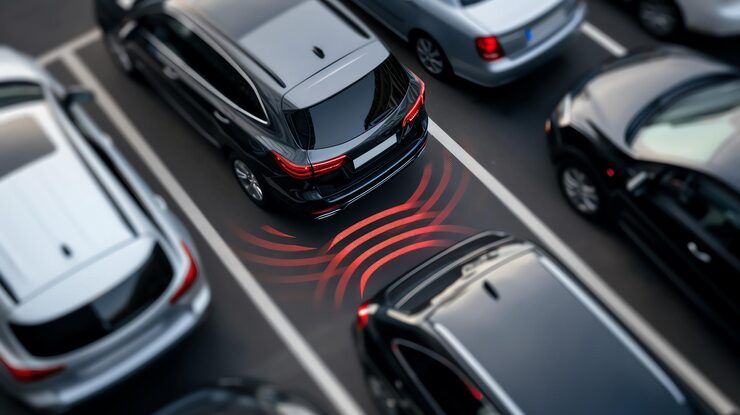
Ultrasonic sensors use high-frequency sound waves to detect nearby objects. They are commonly associated with parking assistance and low-speed object detection.
Because ultrasonic sensors are particularly useful at short distances, they can complement other automotive sensing technologies.
LiDAR Sensors
LiDAR uses laser-based light pulses to measure distances and create information about the surrounding environment. It is being explored and deployed in some advanced automotive applications, particularly where detailed environmental perception is required.
LiDAR technology is also relevant to research and development involving automated driving and advanced vehicle perception.
Automotive Sensors in Electric Vehicles
Electric vehicles use many of the same sensor categories found in conventional vehicles, but their sensing requirements also include electric powertrain and battery-management functions.
Battery temperature sensors, voltage sensors, current sensors, and other monitoring components can provide information required by battery management systems. This data helps monitor battery operating conditions and supports system control.
Electric motor systems also use position and speed sensing to monitor motor operation. As electric vehicle architectures continue to develop, sensor integration remains an important area of automotive electronics.
Automotive Sensors and Vehicle Safety
Vehicle safety systems depend on accurate and timely information. Sensors can detect changes in acceleration, wheel movement, vehicle orientation, pressure, and surrounding objects.
Airbag systems, for example, use crash-related sensing technology to detect rapid changes in vehicle motion. Electronic stability systems can use wheel-speed, steering-angle, and motion information to monitor vehicle behavior.
Modern safety architectures often combine data from several sensors rather than depending on a single measurement.
Automotive Sensor Technology and Connected Vehicles
Connected vehicles generate and exchange large amounts of information through onboard electronic systems and communication networks. Sensors provide much of the underlying data.
Vehicle sensor information can be used for diagnostics, maintenance analysis, fleet monitoring, navigation-related functions, and other connected-vehicle applications, depending on the vehicle architecture and available systems.
The development of automotive software and vehicle connectivity is also increasing the importance of reliable sensor data and electronic data processing.
How Automotive Sensors Work With ECUs
A typical automotive sensing system involves three main stages: measurement, processing, and system response.
First, the sensor detects a physical condition and produces an electrical signal. The signal is then transmitted to an electronic control unit. The ECU processes the information using software and combines it with data from other sensors when required.
The control system can then send instructions to an actuator or another vehicle subsystem. This continuous feedback process allows many vehicle functions to operate automatically.
Factors That Affect Automotive Sensor Performance
Automotive sensors operate in demanding environments. Temperature changes, vibration, moisture, electrical interference, mechanical stress, and contamination can affect sensor performance.
Sensor manufacturers and automotive engineers therefore consider factors such as measurement accuracy, operating temperature range, response time, durability, electromagnetic compatibility, and environmental protection.
The location of a sensor can also influence its performance. Sensors installed near engines, exhaust systems, batteries, or road-facing components may experience particularly demanding conditions.
Automotive Sensor Diagnostics and Maintenance
Modern vehicles can monitor many sensor signals through onboard diagnostic systems. If a sensor produces an abnormal signal or stops communicating correctly, the vehicle may record a diagnostic trouble code.
However, a diagnostic code does not always mean that the sensor itself has failed. Wiring, connectors, power supply, software, or another related component can sometimes produce similar symptoms.
Proper diagnosis therefore involves examining the complete system rather than replacing components based only on a single diagnostic code.
Future of Automotive Sensors
The automotive industry is moving toward increasingly software-defined and electronically integrated vehicles. This development is creating new requirements for sensing, data processing, communication, and system integration.
Sensor fusion is becoming particularly important. Instead of relying on one sensing technology, advanced vehicle systems can combine information from cameras, radar, ultrasonic sensors, inertial sensors, and other sources.
Artificial intelligence and machine-learning technologies are also influencing automotive perception systems. These technologies can process large quantities of sensor data and identify patterns relevant to advanced vehicle functions.
Conclusion
Automotive sensors form a fundamental part of modern vehicle technology. They monitor engine conditions, vehicle movement, temperature, pressure, battery operation, and the surrounding environment.
From basic engine management sensors to radar, cameras, LiDAR, and battery monitoring systems, different sensing technologies serve different purposes. As electric vehicles, connected vehicles, and advanced driver assistance systems continue to develop, automotive sensors are likely to remain an important component of automotive electronics and vehicle safety technology.